
The Toledo City Paper depends on readers like you! Become a friend today. See membership options
Upgrades coming to the UpTown District
The U.S. Department of Transportation has officially approved the city of Toledo’s $20 million RAISE grant project, clearing the way for major infrastructure upgrades.
The redevelopment project is designed to support Toledo’s growing innovation district by replacing aging infrastructure. As a result, city officials believe the upgrades will attract new economic development and improve pedestrian safety.
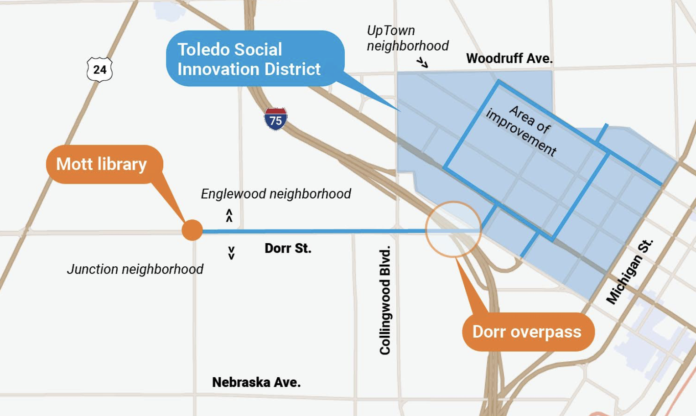
Set to begin construction in 2027, the project will renovate roads, sewer and water lines in the 38 neighborhoods throughout the UpTown District.
“This is such a substantial investment in this particular neighborhood and it’s been in lockstep with the community,” said Brandon Selhorst, chief growth officer for the City of Toledo. “Everything that you see was driven by public feedback that we received directly from the community, so we’re ecstatic that we are now in a position where we can move forward. We received the green light from the federal government to move forward with this project and we’re excited to see what it ultimately can do for the growth of the City of Toledo.”
The project will be completed in phases over the next three years to minimize the impact on residents and businesses.
Creating an innovation district became the catalyst for the project, especially as new economic development partners began looking for ways to drive innovation in the city.
This resulted in a $40 million redevelopment of the Jefferson Center, a vacant former school now known as the Toledo Innovation Center, which will serve as the anchor for the larger innovation district.
“One of the driving forces was the Bitwise Corporation, which announced they were going to establish their first operation outside of California here in the City of Toledo,” said Selhorst. “That really was the impetus for redeveloping the building-about a $40 million redevelopment of the building to be the anchor of a much larger district.”
Once the building redevelopment project started, it allowed the city to look for ways to improve its economic development. Ultimately, officials decided that, to attract new development and investment similar to other cities’ innovation districts, the infrastructure needed to be improved.
This coincided with improving safety throughout Toledo as well, allowing the city to focus on two key issues with one project.
“One of the priorities of the city is to eliminate pedestrian fatalities,” Selhorst said. “Unfortunately, there have been a number of pedestrian fatalities within the corridors that we’re looking to improve and so this grant is going to help us design better transportation infrastructure to hopefully eliminate those fatalities.”
RELATED: Democracy Watch
To go along with the completion of the project, the city has created its Vision Zero goal, aiming to eliminate all roadway fatalities in Toledo by 2031.
“Safety for all road users, whether it be pedestrians, bikes, transit riders or cars, is really kind of one of the guiding priorities of this project and our Vision Zero commitment,” said Simon Nyi, grants commissioner for the City of Toledo. “Our goal is to get to zero roadway fatalities by the year 2031. Pedestrian safety is absolutely a particular issue that we’re focusing on, but this really is safety across the board.”
After research within the neighborhoods, the city decided that the Junction and Englewood neighborhoods needed improved connectivity to downtown, making them the target for the project.
“It became very clear to us that there were two neighborhoods that were cut off from downtown by the building off Interstate 75,” said Selhorst. “The Junction and Englewood neighborhoods didn’t have the safe connection to downtown and the innovation district as some of the other neighborhoods enjoyed. So we decided to focus our efforts on improving that connection for multimodal transportation so that folks within those neighborhoods can access what we’re hoping to build in the innovation center and ultimately within downtown Toledo.”
Altogether, Selhorst believes that investing in the infrastructure is the best way to create new economic growth and improve pedestrian safety for Toledo.
“We are investing in the public right of way to attract developers and companies who want to invest in our city,” Selhorst said. “What we have heard consistently is that it’s challenging for those investments to happen when the condition of the infrastructure is what it is today, where we have water and sewer lines that are 145 years old and are failing. We believe that investing in the right-of-way will lead to additional investment in that neighborhood.”

