
Wednesday, February 11, 2026

Cruising for Lake Erie to End the Harmful Algal Blooms

The Toledo City Paper depends on readers like you! Become a friend today. See membership options

Lake Erie, our wonderful neighboring large body of water, terrific for boating, fishing, and big ships transporting grain, is 241 miles long, with 871 miles of shoreline, the 12th largest lake in the world, and provides drinking water for 11 million people.

Lake Erie Waterkeeper, an environmental organization focused on the health and well-being of Lake Erie, sponsored a 2-hour cruise of Lake Erie on August 6th to highlight the problem of the harmful algal blooms and the phosphorus-laden runoff that feeds them.

The cruise left the Toledo Yacht Club, motoring East for about 30 minutes out into Lake Erie reaching a built up old lighthouse building in the middle of the water, then turned South East until the boat reached another building in the lake and then returned to the Toledo Yacht Club.

About 60 people attended the cruise, including Representative Marcy Kaptur, State Senator Paula Hicks Hudson, and Professor of Ecology at the University of Toledo and Director of the Lake Erie Center Thomas Bridgeman who has conducted research on the harmful algal blooms.

“Always it’s an opportunity to learn and to see what’s going on with the Lake,” said State Senator Paul Hicks Hudson when asked why she attended this cruise, “it’s one of my primary focus in the statehouse to make sure that they don’t forget us down here, don’t forget how important, how vital the health of Lake Erie is.”

“The entire city of Toledo remembers what happened 11 years ago when we were all told that the water coming out of the taps in our homes was poisonous,” said Rep. Marcy Kaptur, “I still get asked around town if the water is safe to drink from my constituents. Our drinking water is safe, but this cruise was to remind us that doesn’t mean that the problem is gone. The Lake still needs our help. I wanted to lend my voice and hear from these champions on the issue about their concerns and hopes for how to improve the water quality.”

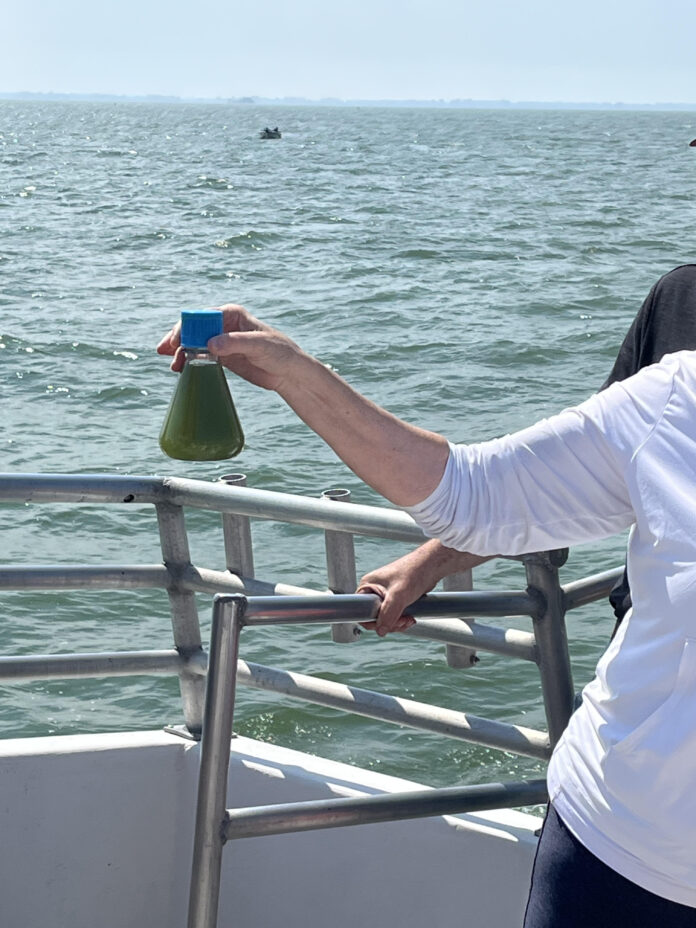
Professor Thomas Bridgeman took a water sample from the boat at the point of the lighthouse.

“The sample that I took was about 20 feet to the surface and it concentrated the blue green algae in the water and compared to other days it was about average for this time of year,” said Bridgeman, “There’s enough there that you could really see the blue green algae but it wasn’t very thick, but so far this bloom is looking like an average bloom that we’ve had over the last 3 or 4 years. Which fortunately is a lot smaller than it was 10 years ago, we had huge blooms in 2011 and 2015 so I think because we’ve tended to have less rainfall in the Spring, we’ve been getting smaller blooms.”

I noted that I couldn’t see any algae on top of the water during the cruise.

“It’s normal for a day like today because it’s kind of windy and the water is mixing all the way from the top to the bottom,” says Bridgeman, “If it was a calm day, you would see a surface scum of bright green algae on the surface.”

“The purpose of this cruise is to just raise public awareness of the harmful algal bloom issue and Lake Erie,” says Bridgeman, “it’s an eye-opening cruise. If even only a few people sort of realize something that they didn’t before and become interested in the issues facing Lake Erie, if only a few people take on the challenges, I think it’s a success.”

“The Lake is sick. It’s painfully obvious when you see the bright green water sample we collected on our cruise,” added Rep. Kaptur, “Thousands of Ohioans and Michiganders enjoy the Lake every year and there’s no better way to reconnect with nature than a day at the beach or out on the Lake fishing.  I want all of us to be able to enjoy the beauty of our region and to not have to worry about their health and safety that a bad algal bloom might endanger.”

The largest algal bloom, made up of cyanobacteria, approximately 160 square miles large, is found in Western Lake Erie from Maumee Bay north to Monroe, Michigan and east to Port Clinton. Another sizeable algal bloom is in Sandusky Bay. Toxins have been detected in Sandusky Bay and can exceed the recreational limit (8 micrograms per liter microcystin), according to Lake Erie Waterkeeper.

Perhaps you recall in August 2014 Toledo experienced a drinking water crisis when the harmful algal bloom contaminated Toledo’s drinking water with microcystin, resulting in a “do not drink the water” warning that lasted three days.

While our drinking and bathing water has been since safeguarded, the harmful algal blooms persist and are fed by phosphorus coming from agricultural fertilizer runoff, farm animal manure runoff, wastewater, and storm water. Lake Erie Waterkeeper highlighted the manure problem, showing that the number of farm animals in the Maumee Basin increased from 350,000 in 2002 to about 650,000 by 2017.

Ohio, Michigan, and Ontario signed an agreement in 2015 aiming to achieve phosphorus reductions, a 40 percent reduction in phosphorus in runoff by 2025, with an interim goal of 20 percent by 2020.

But according to Lake Erie Waterkeeper, that agreement has failed, with reports showing little to no phosphorus reductions, though reportedly $1 billion has been spent to reduce agricultural runoff. Wastewater plants are also spending billions to reduce sewage overflows.

What’s needed to reduce the phosphorus runoff into the lake is “The Lake Erie Phosphorus Reduction 4 R’s,” says Sandy Bihn, Executive Director of Lake Erie Waterkeeper, “Reduce and target largest phosphorus locations, right resources and funding for phosphorus reductions, report phosphorus reductions, and require offsets for phosphorus additions.”

Hopefully the state of Ohio, the federal government, and the City of Toledo can work together to reduce phosphorus-laden runoff into lake Erie.  “We need to do more to support farmers to adopt the best practices for reducing pollution from running off into the streams and rivers,” said Rep. Kaptur, “technological innovation must be at the forefront of our investment.  We have a lot of science and testing showing that there are farming practices that limit runoff and increase crop yield — how can we work together to get these options into the field?  We have to help our farmers make the economics work and continue to work regionally to stop algal-bloom-inducing pollution at the source.”

The Toledo City Paper depends on readers like you! Become a friend today. See membership options

Lake Erie, our wonderful neighboring large body of water, terrific for boating, fishing, and big ships transporting grain, is 241 miles long, with 871 miles of shoreline, the 12th largest lake in the world, and provides drinking water for 11 million people.

Lake Erie Waterkeeper, an environmental organization focused on the health and well-being of Lake Erie, sponsored a 2-hour cruise of Lake Erie on August 6th to highlight the problem of the harmful algal blooms and the phosphorus-laden runoff that feeds them.

The cruise left the Toledo Yacht Club, motoring East for about 30 minutes out into Lake Erie reaching a built up old lighthouse building in the middle of the water, then turned South East until the boat reached another building in the lake and then returned to the Toledo Yacht Club.

About 60 people attended the cruise, including Representative Marcy Kaptur, State Senator Paula Hicks Hudson, and Professor of Ecology at the University of Toledo and Director of the Lake Erie Center Thomas Bridgeman who has conducted research on the harmful algal blooms.

- Advertisement -

“Always it’s an opportunity to learn and to see what’s going on with the Lake,” said State Senator Paul Hicks Hudson when asked why she attended this cruise, “it’s one of my primary focus in the statehouse to make sure that they don’t forget us down here, don’t forget how important, how vital the health of Lake Erie is.”

“The entire city of Toledo remembers what happened 11 years ago when we were all told that the water coming out of the taps in our homes was poisonous,” said Rep. Marcy Kaptur, “I still get asked around town if the water is safe to drink from my constituents. Our drinking water is safe, but this cruise was to remind us that doesn’t mean that the problem is gone. The Lake still needs our help. I wanted to lend my voice and hear from these champions on the issue about their concerns and hopes for how to improve the water quality.”

Professor Thomas Bridgeman took a water sample from the boat at the point of the lighthouse.

“The sample that I took was about 20 feet to the surface and it concentrated the blue green algae in the water and compared to other days it was about average for this time of year,” said Bridgeman, “There’s enough there that you could really see the blue green algae but it wasn’t very thick, but so far this bloom is looking like an average bloom that we’ve had over the last 3 or 4 years. Which fortunately is a lot smaller than it was 10 years ago, we had huge blooms in 2011 and 2015 so I think because we’ve tended to have less rainfall in the Spring, we’ve been getting smaller blooms.”

I noted that I couldn’t see any algae on top of the water during the cruise.

“It’s normal for a day like today because it’s kind of windy and the water is mixing all the way from the top to the bottom,” says Bridgeman, “If it was a calm day, you would see a surface scum of bright green algae on the surface.”

“The purpose of this cruise is to just raise public awareness of the harmful algal bloom issue and Lake Erie,” says Bridgeman, “it’s an eye-opening cruise. If even only a few people sort of realize something that they didn’t before and become interested in the issues facing Lake Erie, if only a few people take on the challenges, I think it’s a success.”

“The Lake is sick. It’s painfully obvious when you see the bright green water sample we collected on our cruise,” added Rep. Kaptur, “Thousands of Ohioans and Michiganders enjoy the Lake every year and there’s no better way to reconnect with nature than a day at the beach or out on the Lake fishing.  I want all of us to be able to enjoy the beauty of our region and to not have to worry about their health and safety that a bad algal bloom might endanger.”

The largest algal bloom, made up of cyanobacteria, approximately 160 square miles large, is found in Western Lake Erie from Maumee Bay north to Monroe, Michigan and east to Port Clinton. Another sizeable algal bloom is in Sandusky Bay. Toxins have been detected in Sandusky Bay and can exceed the recreational limit (8 micrograms per liter microcystin), according to Lake Erie Waterkeeper.

Perhaps you recall in August 2014 Toledo experienced a drinking water crisis when the harmful algal bloom contaminated Toledo’s drinking water with microcystin, resulting in a “do not drink the water” warning that lasted three days.

While our drinking and bathing water has been since safeguarded, the harmful algal blooms persist and are fed by phosphorus coming from agricultural fertilizer runoff, farm animal manure runoff, wastewater, and storm water. Lake Erie Waterkeeper highlighted the manure problem, showing that the number of farm animals in the Maumee Basin increased from 350,000 in 2002 to about 650,000 by 2017.

Ohio, Michigan, and Ontario signed an agreement in 2015 aiming to achieve phosphorus reductions, a 40 percent reduction in phosphorus in runoff by 2025, with an interim goal of 20 percent by 2020.

But according to Lake Erie Waterkeeper, that agreement has failed, with reports showing little to no phosphorus reductions, though reportedly $1 billion has been spent to reduce agricultural runoff. Wastewater plants are also spending billions to reduce sewage overflows.

What’s needed to reduce the phosphorus runoff into the lake is “The Lake Erie Phosphorus Reduction 4 R’s,” says Sandy Bihn, Executive Director of Lake Erie Waterkeeper, “Reduce and target largest phosphorus locations, right resources and funding for phosphorus reductions, report phosphorus reductions, and require offsets for phosphorus additions.”

Hopefully the state of Ohio, the federal government, and the City of Toledo can work together to reduce phosphorus-laden runoff into lake Erie.  “We need to do more to support farmers to adopt the best practices for reducing pollution from running off into the streams and rivers,” said Rep. Kaptur, “technological innovation must be at the forefront of our investment.  We have a lot of science and testing showing that there are farming practices that limit runoff and increase crop yield — how can we work together to get these options into the field?  We have to help our farmers make the economics work and continue to work regionally to stop algal-bloom-inducing pollution at the source.”

Recent Articles

Our Latest Digital Issue

Toledo City Paper
Privacy Overview

This website uses cookies so that we can provide you with the best user experience possible. Cookie information is stored in your browser and performs functions such as recognising you when you return to our website and helping our team to understand which sections of the website you find most interesting and useful.