
The Toledo City Paper depends on readers like you! Become a friend today. See membership options
Baseball fans know the feeling. A sharp grounder eats up a third baseman. A slow roller forces a throw on the run. A diving stop turns into an infield single. In those moments, thousands of eyes shift to the scoreboard, waiting for the verdict that decides whether the play becomes a hit or an error. Somewhere up in the press box, one person makes that call.
For more than 20 years, that person in Detroit has often been Perrysburg native Ron Kleinfelter, a veteran Major League Baseball official scorer whose job demands rulebook precision, split-second judgment, and a level of detail most fans never see. It is not glamorous. It is not loud. But it matters.
“A lot of people think you are getting paid to watch baseball. I’m not… I am concentrating on virtually everything that is going on in that field at any given time.”
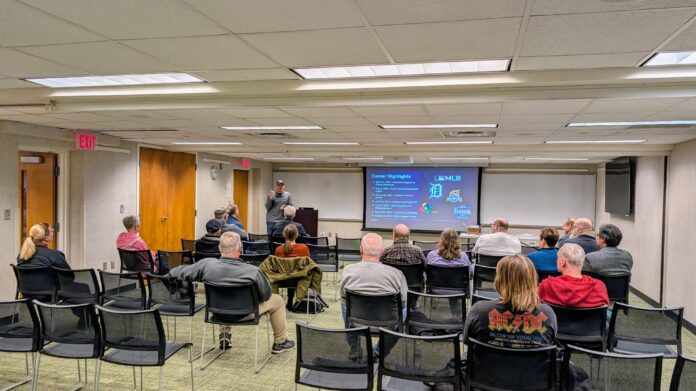
To many fans, scoring is a part of baseball that they rarely think about. And on November 16, at the Way Public Library, he welcomed the chance to share what he has learned.
For about two hours, the man whose work is usually seen only through a tiny “H” or “E” on a scorecard finally stepped out from behind the press box glass and showed fans just how much thought goes into the calls they react to every night.
A lifelong student of the game
Kleinfelter shared that his path to MLB scoring did not begin with a playing career or a front office connection. It began with scorecards.

He remembers going to Cincinnati Reds games as a kid in the late 1970s, watching his father keep score and becoming fascinated with the symbols, the structure and the way the whole game could be tracked on paper. By the time he was 12, he was scoring games off the television.
“I was always fascinated by the rules,” he shared. “I liked the organization of it. I liked being able to look at the sheet and know exactly what happened,” he added.
“I think baseball is one of the most beautiful things in terms of structure and tradition.”
That early fascination laid the groundwork for a career that now spans more than 20 years in Detroit and nearly three decades in Toledo with the Mud Hens.
Right place, right time, right skills
Kleinfelter’s break into professional scoring came in 1999 through a classic minor league moment. The Mud Hens needed a scorer, a friend vouched for him, and by April 14, 1999, he was calling his first professional game at old Ned Skeldon Stadium in Maumee.
He still remembers the date perfectly.
“It was the classic ‘right place and right time’,” he said. “If that conversation hadn’t happened, I might not be doing this today.”
Years later, that same timing worked again when the Detroit Tigers needed a new scorer before the 2005 season. Kleinfelter reached out, made the right connection and has been with MLB ever since.
In a typical season, Kleinfelter scores about 35 Tigers home games each season, another 26 with the Mud Hens, and works hundreds more remotely as part of MLB’s support team.
The standard of scoring: ordinary effort
Out of the more than 1,000 career games scored between Detroit and Toledo, Kleinfelter says every scoring decision comes down to two words.
Ordinary effort.
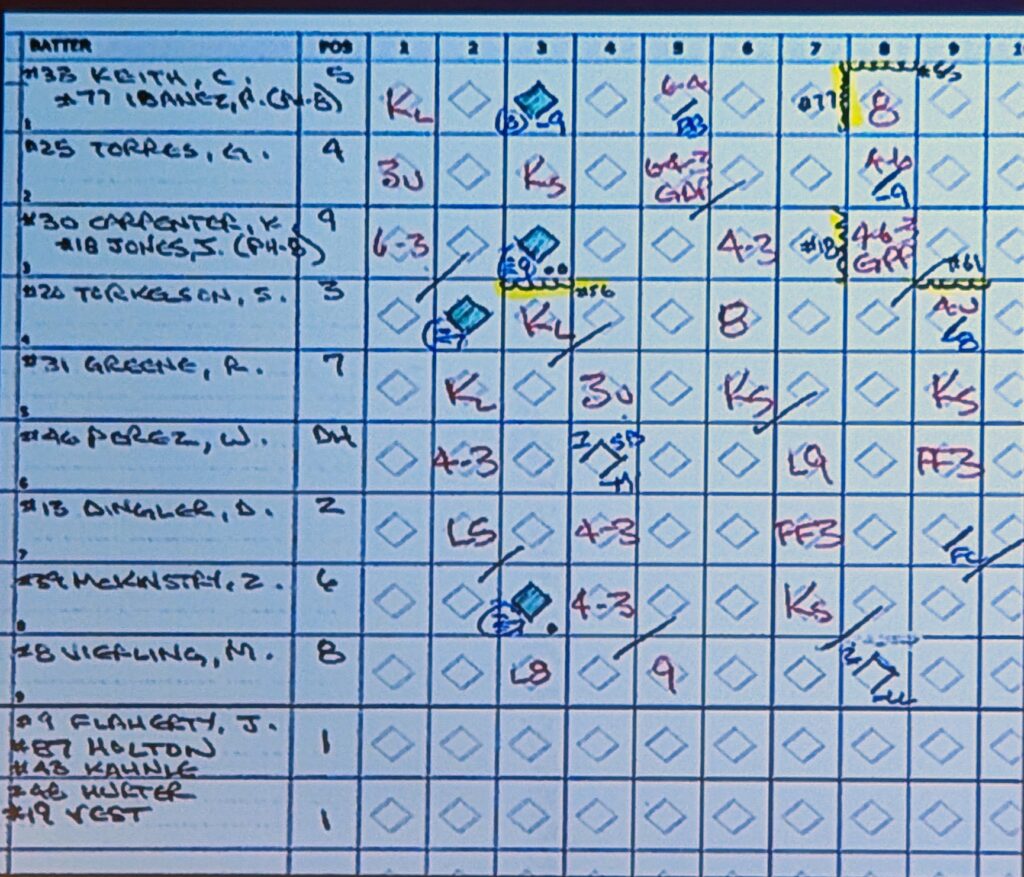
Those words determine whether a play becomes a hit or an error. Whether a fielder realistically should have made the play, and whether the batter earns credit or a defender gets charged.
“If a shortstop has to dive or leave his feet or deal with a crazy hop, that is almost always beyond ordinary effort,” Kleinfelter said. “You cannot punish a fielder for not making a spectacular play.”
Fans may not always like the call, and players may not like it either, but the standard always remains consistent on his scorecard.
The heat of the moment
Kleinfelter has been part of some of Detroit’s most pressure-filled moments. One that still stands out was on April 23, 2011, when Tigers pitcher Brad Penny carried a no-hitter into the middle innings against the Chicago White Sox.
He remembers it as if it were yesterday.
“A chopper down the line… a backhand by Brandon Inge… a difficult throw that pulled the first baseman. The runner beat it out.”
Kleinfelter ruled it a hit immediately, and 40,000 fans disagreed.
“They booed me pretty good,” he said, laughing. “But it was the right call. It was beyond ordinary effort. I would have called it the same way whether it was the first inning or the ninth with two outs in a no-hitter.”
The next day, the manager of the Tigers at the time, Jim Leyland, publicly backed him, calling it the correct ruling and praising the decisiveness of the call.
RELATED: Sports Zone: “Live from the Nickel” Puts Toledo Sports and Community in the Spotlight
Scoring fast
Even with decades of experience, the speed of the job never slows down. Scorers have about 30 seconds to make a hit or error ruling before the next batter steps in, a window that can feel impossibly tight on the so-called 50-50 plays.
To help, MLB gives scorers access to a replay support system nicknamed NORAD.
No, it has nothing to do with aerospace defense.
Rather, it simply allows Kleinfelter to pull up alternate angles within seconds and send them to the scorer in the stadium, working off the live feed.
“They only get what they see in real time,” he said. “I can dig for the angles they don’t have the time to find.”
Under the most recent MLB Collective Bargaining Agreement, any scoring decision can be appealed within 72 hours. Players submit appeals through an app on their phone, and once it is filed, the play is routed to a committee of three reviewers for evaluation. After the committee studies the video and the reasoning behind the original ruling, a final decision is issued and communicated back to the player and the team.
“It is part of the job,” Kleinfelter said. “If a player feels strongly about something, they have that right. All you can do is be confident in the call you made.”
Another memorable moment came in 2007 when Kleinfelter’s ruling in the first inning ended Placido Polanco’s MLB record errorless streak at second base. Later that night, after reviewing additional information and consulting with the umpire who had the best view, he reversed the call.
“I went back and looked at everything available. You have to get it right,” he said. “We have up to 24 hours to review a call and correct it. That is part of the job.”
What makes a good scorer
When asked what separates great scorers from the average ones, Kleinfelter did not hesitate to list three essential traits.
- You need to master Section 9 of the MLB rulebook.
- You need a feel for the game’s speed and rhythm.
- And above all, you need absolute attention to detail.
“It is not sitting back with nachos and a beer,” he said. “It is intense concentration and tracking every little detail of every single game. That is what it takes to be good at this.”
Integrity in the age of sports betting
As sports betting expands nationwide, Kleinfelter acknowledges that the landscape of MLB has changed. Scoring decisions can influence props, parlays and payouts. And while he always ensures it does not affect his work, he is aware of the added pressure surrounding the role.
“It’s one of my biggest concerns,” he said. “You worry that someone might take a judgment call personally because it affected a bet. I just hope betting stays fun and doesn’t threaten the integrity of the game,” he said, adding that MLB scorers are forbidden from betting on baseball at any level, even in youth games. Violations result in immediate termination.
Home in Perrysburg, eyes on the big leagues
Despite working on baseball’s biggest stages, Kleinfelter remains grounded in his hometown community.
He points to the long line of Perrysburg ties to Detroit. Former Tigers manager Jim Leyland, longtime clubhouse manager Jim Schmakel, media staffers, friends, and even Leyland’s late brother, Father Tom Leyland, who married Ron and his wife.
“It has always been something I am proud of,” Kleinfelter said. “I love where I am from.”
He rarely advertises his role. At games, he blends into the press box, focused on the field. Then around town, he keeps a low profile.
And whether he is in Detroit or at home in Perrysburg, he remains the same steady presence whose work is noticed only when it flashes on a scoreboard.
At 56, Kleinfelter has no plans to stop scoring games and hopes to keep going another 15 to 20 years.
“I love it,” he said simply. “I am honored to do it.”

