
Sunday, January 18, 2026

City Pages: Finding Strength Through Story: Anneke Kurt on Heard and Listening to Life

The Toledo City Paper depends on readers like you! Become a friend today. See membership options

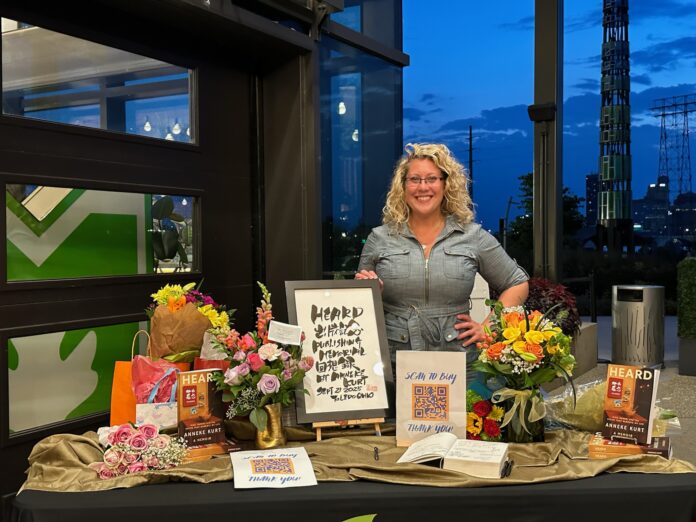
Anneke Kurt knows how important it is to feel seen in this crazy world. Even more essential, she knows how it feels to be truly heard. Her memoir (titled Heard) is all about reclaiming her voice — so she not only is heard by those she cares for, but also so she rediscovers her inner voice while learning to listen to her heart.

Beyond the kitchen: A story larger than restaurant life

Anneke, the corporate manager of Kengo Sushi & Yakitori, Kato Ramen and Papa Kato’s Karaage in Toledo’s Warehouse District, titled her memoir as a cheeky play on a phrase common in restaurant kitchens: “Heard!”

Ramen and restaurant metaphors aside, Kurt’s memoir is much more than the chaos and adrenaline-fueled sagas often chronicled in restaurant retrospectives. She actually found meditative bliss in the repetitive cycle of kitchen life. “The adrenaline and chaos of the restaurants were — and still are — tame and predictable com- pared to the disorder and instability I was hiding, that found solace in the hot, rushed, stressful madness that is a bustling restaurant.”

A year of loss, change and unraveling
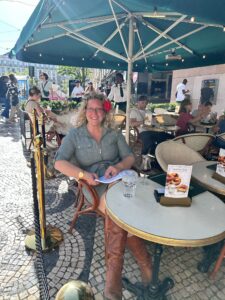
Working on her book, Anneke sits at the Café a Brasileira in Lisbon, the regular haunt of Portugal’s most famous poet, Fernando Pessoa.

In March 2025, Anneke was reeling from an intense break-up. At 41 years old, the split hit harder than a usual ‘parting of ways,’ and she had to come to terms with the fact that with the closure of this relationship also came the confirmation that she would bear no more children.

Rather than wallow in her pain, she channeled her grief, embarking on an Eat, Pray, Love journey of personal transformation. She got a refund for the ski trip she had arranged with her ex and instead traveled solo to Amsterdam, Lisbon and Greece.

Her goal for that trip was to finish the book she had been working on for years. With a background in the world of legal marketing, and although she has written books and web content before, the words she had written had always been in someone else’s voice, telling someone else’s story.

The chance to tell her own story

Heard was the first time I was writing for myself,” explains Anneke, “ . . .my story as I experienced it. There was a lot of fear attached to that. Some of these truths I had never ‘spoken’ out loud, let alone memorialized on paper. That was scary, and extremely emotional.”

Learning to hear the quiet parts of herself

As Anneke wrote, traveled and contemplated her own truth, she began to understand that the story she was telling wasn’t just about heartbreak — it was about finally listening to the parts of herself she had spent years quieting. Away from the noise of obligation and expectation, she found clarity in the simple routines of solo travel: long walks through cobblestone streets, silent mornings with coffee, unhurried hours spent writing in cafés by the water. “Now I seek out the intuition instead of ignoring it for as long as pos- sible,” Anneke explains.

With Heard now out in the world, Anneke is turning toward connection. She hopes the memoir opens conversations about healing, choice and the courage to rewrite one’s own narrative. And she has begun drafting new pieces of writing, exploring themes that surfaced in her travels but didn’t fit neatly into the book.

Purchase Heard at themarketink.com/#heard.


READ THE FULL INTERVIEW HERE:

  1. Heard is a memoir, but it’s also about reclaiming your voice. How did writing the book change your understanding of who you are outside of roles—manager, sister, problem-solver? 
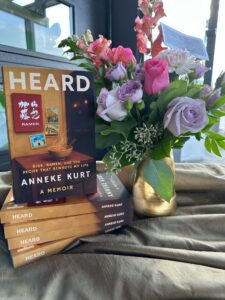
Anneke’s memoir, Heard: Risk, Ramen, and the Recipe That Rewrote My Life.

We all have some level of imposter syndrome at some point in our lives. Mine was pretty heavy and there was a long period of time where I was in “survival mode;” just trying to make it through the day dry-eyed and in one piece when my personal life was falling apart. When I went back through my writing, compiling all my thoughts and ideas for the purpose of the book, I was closer to the other side of it and closer to my “true self” – the person I was no longer afraid of hiding. The light I had allowed others to dim for so long was getting brighter. Re-reading and organizing all of the words I wrote during a horrible time in my life unearthed this realization that I was a whole lot stronger than I had given myself credit for. Instead of mom, manager, sister, problem-solver, I realized that underneath that pain and struggle was a storyteller, a strategist, a rebuilder. And in a way, a mirror. I realized that in my career, I had found a way to help people see themselves and their businesses in a way that they cannot see in themselves, just like the people along my journey had done for me. 

  1. When in the writing process did you realize the book was becoming something more than a story about opening a restaurant?

The moment I got off the plane in Amsterdam. In March of this year, I was still nursing the wounds and the pain of rejection that caused a real sorrow in coming to terms with that, at 41-years-old, the closing of a relationship’s door also closed the door on having more kids. Instead of wallowing like I wanted to, I channeled the pain into something productive and booked a two-week solo trip to visit Amsterdam, Lisbon, and Greece with the intention of finishing the book I had been working on for years.

All my notes and chapter ideas were perfectly organized into an outline with corresponding notecards. Starting on the plane, I found myself writing about what was happening in real time and as we were descending, I felt this overwhelming sense that I was coming home, which only heightened the pull to capture everything around me. I touched the notecards not once during that trip. Instead, so many pages reflect the magic that the trip created and the healing that the impromptu excursion brought.

  1. You’ve ghostwritten and drafted other manuscripts. What made the writing experience on Heard different creatively or emotionally?

The other books and web content I’ve written during my legal marketing career were always in another person’s voice, with a specific audience in mind, on subject matters that were fairly dry and devoid of much emotion. Other than touching on what the audience was probably feeling as they dealt with the legal matter they were facing, the publications were more educational and used as tools to position the attorney as an expert in his or her field. With Heard, it was the first time I was writing for myself. It was my story as I experienced it. 

There was a lot of fear attached to that. Some of these truths I had never “spoken” out loud, let alone put permanently on paper. That was scary and extremely emotional. 

I remember saying to Kengo right before I published the book, “I just don’t know why I’m so anxious over this. What if no one wants to read it or if they hate it?”

His response changed my whole outlook.

He simply said, “So what? It’s your story.”

He was right. 

  1. How did you shape the structure of the memoir—were there any scenes or chapters that changed the entire arc once you wrote them?

After spending two weeks writing about all the things happening around me in Europe, I was worried about finding a way to weave the new chapters into what I had already written back home. But a common theme kept presenting itself: fate. So much of the book was already about sitting with pain and sitting with being unsure and embracing the unknown all while being willing to just close your eyes and press forward, expecting to fail, trusting that the growth would come from the failure. So many “fateful” or “serendipitous” or “meant to be” moments happened in Europe that I absolutely could not ignore. Those moments put a glaring spotlight on the serendipitous moments that had already happened in my life in the US that I hadn’t realized were just that: pain that was meant to happen, opportunities that were meant to occur, happenstance meetings that were pre-determined by something bigger than all of us. 

One night in Lisbon really turned into a lightbulb moment that shifted everything. That night I made such profound peace with the people who had caused so much pain that it turned into a deep gratitude for the “bad” things that had happened. I made peace with my own hurt and longing, transforming it into deep gratitude for the way life unceremoniously took away the things I thought I wanted more than anything.

I remember writing in my notebook the Rolling Stones lyric that had whispered in my ear for years: “You can’t always get what you want. You get what you need.”

  1. Many restaurant-memoirs focus on adrenaline and chaos; Heard feels more reflective. Was that an intentional stylistic decision?

The adrenaline and chaos of the restaurants were – and still are – so tame and predictable compared to the disorder and instability I was used to hiding that I think I found solace in the hot, rushed, stressful madness that is a bustling restaurant. Anything in a chaotic restaurant can be smoothed over with transparency and kindness and understanding – whether it’s with a guest, a co-worker, a Chef – as long as you’re willing to take accountability and embody patience. Those tactics don’t always work (no matter how hard you try) when you’re in an unsafe relationship. The chaos throws you off balance way more. In restaurants, no matter the chaos, you know that there is a threshold: the check is paid, the guest eventually leaves, there is an inevitable closing time. That light at the end of the tunnel of each night, each project, each restaurant’s opening buoyed me. It was almost like a life-preserver I wasn’t used to having.

  1. The Blade mentions the “Ramen Bible.” From a writer’s perspective, what’s the significance of that object? Is it a craft tool, a metaphor, a talisman—or something else?

Worn and tattered now and held together by blue painter’s tape, at its inception, the 4-inch-thick hardcover notebook I started when I began the project looked like a big, thick library book. It became home to every thought, question, idea, measurement, experiment, and to-do list having to do with the project of opening Kato Ramen. 

It is now stained with smeared ink, broth, grease, and coffee; lined with sticky notes and painter’s tape as dividers; and has stapled inside mementos like first tickets printed from new POS systems, clock-out slips, and important receipts. Part dairy, part to-do, the book became known as The Bible. 

It went with me everywhere; I could always be found with a Pilot G-2 1.0 black pen behind my ear and the Bible in hand. Furiously scribbling notes or reaching over to jot down a measurement or sketching out a kitchen layout or logo – it all went in the Bible. Eventually it also captured all the planning and notes for Shobu by Kengo and Papa Kato Karaage. 

Reading back on the Bible for the purpose of the book, I can actually see myself learning. My early entries are dotted with so many question marks; reminders to myself to keep seeking answers. The way I document things becomes more assertive and confident over time. Notes that seem to tip-toe at first as I figured out what the hell I was doing gave way to projections built on real experience instead of guestimation. It’s like watching me grow up on paper. 

  1. Did keeping that working journal change the way you observe the world or track your own growth?

Yes, definitely. I’ve never been much of a goal-setter on paper. Tracking progress doesn’t come naturally to me, but taking hand-written notes does. I learn much better by physically writing things down versus typing them out or watching screens. Writing with pen on mini notebooks I carry with me everywhere now is an extension of those years writing in the Bible. Some people document their lives by taking videos. My poignant moments are captured in ink. 

  1. You write about learning to trust your gut. What does intuition look like for you now—especially when managing people, balancing multiple businesses, or making creative choices?

Forcing things to happen a certain way or “making it work” because that’s how it’s always been done or because a tough conversation would be avoided is no longer an option. No longer being afraid of the unknown and embracing the possibility of a mistake has helped me trust my gut right off the bat instead of eventually relenting to its nagging. Now I seek out the intuition instead of ignoring it for as long as possible. 

  1. Is there a moment not in the book that you now realize was pivotal in reshaping your life?

The moment I chose to speak up and admit that there was something wrong behind closed doors. There is power and a huge amount of relief in revealing the truth, as shameful as you feel about it. When you are trying to hide the bad, the amount of energy the secret sucks from you is immense. The moment I allowed myself to be vulnerable, admit that things were not OK, and accept help, the fear of revealing the secret dissipated and no longer debilitated me. I could move forward with intention instead of stumbling through survival, reacting out of fear. 

  1. You’ve talked about “extraordinary ordinary people” you met while traveling. How did those encounters influence your ideas about hospitality, belonging, or storytelling?
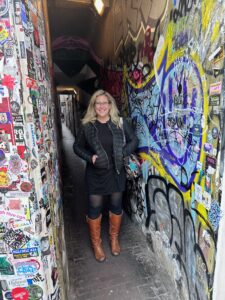
Anneke Kurt stands on Trompettersteeg (Trumpeter Street), the most narrow street in Amsterdam.

At the end of the day, we all want to be heard. And we all have felt at some point in our lives that what we have to say isn’t valuable enough for someone to take the time to listen or that our words don’t necessarily matter. 

I also feel like it is not uncommon for people to fall into the trap of looking for the next big thing, the shinier thing, the bigger thing, the greener thing. 

But there is so much beauty in the every day. The mundane can be magical if you let it. Instead of taking up so much time searching with your blinders on for something extraordinary, take the few minutes to look around you at the “ordinary” and you will find the extraordinary. Writing down my encounters with the restauranteur who took me to my seat at the Portuguese steakhouse, the woman who rented me the car in Greece, the man who served me French fries in the souvlaki taverna, the older couple who shared a passionate kiss at the airport, the woman who suggested the perfect color at the dress shop, the young guy who drove me around in a tuk tuk, woman who cared for her mother at the same time caring for her guests in her bed and breakfast by the sea, the soft-spoken traveler who showed me Grecian olive groves, the woman I used to babysit for in Amsterdam, the American who opened a bar in Lisbon after her 5th divorce, the young couple on their first trip together who happened to have a connection to the old St. Luke’s in Toledo: it all contributed to my story and the book that was longing to finally escape my heart. 

They are all just your salt-of-the-earth people going about their lives the same way I was. But their stories weaved in and out of mine so seamlessly, leaving behind lessons of resilience and beauty and calm and discipline and faith and perseverance that will stay with me forever. I heard them and they heard me and now our stories will live on in a book far after we all depart the earth. 

You get what you put out in the world. If you want to be heard, the easiest way to do that is to listen. And in my case, write down what you hear.  

  1. What cultural or philosophical ideas guided you while writing? (Japanese hospitality? Dutch practicality? Something else entirely?)

Japanese discipline and consistency and the European passion are common themes in the book. Taking the bits and pieces that resonate with you from each culture you encounter is a great way to learn about yourself and shape the person you want to become. Discovering that it is entirely possible to be regimented like the Japanese, spontaneous like the Portuguese, literal and frugal like the Dutch, and social like the Greeks all at the same time has been eye-opening. 

  1. You mentioned wanting to dedicate a second memoir to Papa Kato’s Karaage. What questions about yourself or your work life are still unresolved—and could become material for future writing?

I’m curious to explore the differences in how I approached the Kato Ramen project, the contract negotiations for Shobu by Kengo, and the Papa Kato Karaage project all in relation to what was going on in my life at the time and how far along I was in the EMDR process at each point. EMDR has had a profound effect on my life, and I credit it and my EMDR therapist Aiysha Snyder at the Karuna House in Sylvania for the lifeline I needed when talk therapy wasn’t doing the trick. EMDR stands for Eye Movement Desensitization and Reprocessing and it’s a psychotherapy that helps people heal from trauma by processing distressing memories by recalling a disturbing event while simultaneously engaging in bilateral stimulation (in my case, I held a small buzzer in each hand that would alternate vibrations). I’ve been through around 40 sessions, and it has helped me not only as a person but also in my career. It’ll be interesting to delve into that more in the next book. 

  1. When readers finish Heard, what conversation do you hope they have with themselves?

My hope is that reading Heard gives people the courage to embrace what feels like “failure” so they realize that hitting rock bottom isn’t disaster – it’s a gift. Mistakes and bad choices and inadvertently ignoring red flags and falling on your face are a part of what is meant to happen. Sit with the pain and the shame instead of burying it, take accountability and inventory of what went wrong, and you’ll be an even better version of yourself if you’re willing to pick yourself up and keep going. You might be dusty and bloody and tear-stained and bruised, but there is always something worth it hiding farther up the path and doing what it takes to get yourself there will make you stronger along the way. 

  1. Toledo has a tight-knit creative and culinary community. How has Heard been received in circles outside the restaurant world?

It’s still early, but so far, I think people really like it. 

  1. Do you see the book as part of a broader cultural moment in Toledo—women telling their stories, independent publishing, or local food culture evolving?

I hope that it sparks a movement of more women in the restaurant world beyond the front of house. Even though so many restaurants begin with recipes from women who never wanted their families to go hungry, it’s not as common to see women in chefs’ coats. Chef Erika Rapp of Registry Bistro is paving the way and there are so many strong women working quietly in the background – like Karyn Hajjar, Joy Hajjar, and Stacy Lapoint of the Beirut family of restaurants; Kara Salloukh of Souk and Sabira; Megan Lingsweiler of The Standard – making magic happen. 

From the depths of these kitchens and the depths of our hearts where we keep things hidden away, I know more stories will emerge. Especially with men like Kengo and Labib and Elias and Nasri and Moussa and Jeff supporting women and encouraging their stories to be passed down.
The Toledo City Paper depends on readers like you! Become a friend today. See membership options

Anneke Kurt knows how important it is to feel seen in this crazy world. Even more essential, she knows how it feels to be truly heard. Her memoir (titled Heard) is all about reclaiming her voice — so she not only is heard by those she cares for, but also so she rediscovers her inner voice while learning to listen to her heart.

Beyond the kitchen: A story larger than restaurant life

Anneke, the corporate manager of Kengo Sushi & Yakitori, Kato Ramen and Papa Kato’s Karaage in Toledo’s Warehouse District, titled her memoir as a cheeky play on a phrase common in restaurant kitchens: “Heard!”

Ramen and restaurant metaphors aside, Kurt’s memoir is much more than the chaos and adrenaline-fueled sagas often chronicled in restaurant retrospectives. She actually found meditative bliss in the repetitive cycle of kitchen life. “The adrenaline and chaos of the restaurants were — and still are — tame and predictable com- pared to the disorder and instability I was hiding, that found solace in the hot, rushed, stressful madness that is a bustling restaurant.”

A year of loss, change and unraveling

Working on her book, Anneke sits at the Café a Brasileira in Lisbon, the regular haunt of Portugal’s most famous poet, Fernando Pessoa.

In March 2025, Anneke was reeling from an intense break-up. At 41 years old, the split hit harder than a usual ‘parting of ways,’ and she had to come to terms with the fact that with the closure of this relationship also came the confirmation that she would bear no more children.

- Advertisement -

Rather than wallow in her pain, she channeled her grief, embarking on an Eat, Pray, Love journey of personal transformation. She got a refund for the ski trip she had arranged with her ex and instead traveled solo to Amsterdam, Lisbon and Greece.

Her goal for that trip was to finish the book she had been working on for years. With a background in the world of legal marketing, and although she has written books and web content before, the words she had written had always been in someone else’s voice, telling someone else’s story.

The chance to tell her own story

Heard was the first time I was writing for myself,” explains Anneke, “ . . .my story as I experienced it. There was a lot of fear attached to that. Some of these truths I had never ‘spoken’ out loud, let alone memorialized on paper. That was scary, and extremely emotional.”

Learning to hear the quiet parts of herself

As Anneke wrote, traveled and contemplated her own truth, she began to understand that the story she was telling wasn’t just about heartbreak — it was about finally listening to the parts of herself she had spent years quieting. Away from the noise of obligation and expectation, she found clarity in the simple routines of solo travel: long walks through cobblestone streets, silent mornings with coffee, unhurried hours spent writing in cafés by the water. “Now I seek out the intuition instead of ignoring it for as long as pos- sible,” Anneke explains.

With Heard now out in the world, Anneke is turning toward connection. She hopes the memoir opens conversations about healing, choice and the courage to rewrite one’s own narrative. And she has begun drafting new pieces of writing, exploring themes that surfaced in her travels but didn’t fit neatly into the book.

Purchase Heard at themarketink.com/#heard.


READ THE FULL INTERVIEW HERE:

  1. Heard is a memoir, but it’s also about reclaiming your voice. How did writing the book change your understanding of who you are outside of roles—manager, sister, problem-solver? 
Anneke’s memoir, Heard: Risk, Ramen, and the Recipe That Rewrote My Life.

We all have some level of imposter syndrome at some point in our lives. Mine was pretty heavy and there was a long period of time where I was in “survival mode;” just trying to make it through the day dry-eyed and in one piece when my personal life was falling apart. When I went back through my writing, compiling all my thoughts and ideas for the purpose of the book, I was closer to the other side of it and closer to my “true self” – the person I was no longer afraid of hiding. The light I had allowed others to dim for so long was getting brighter. Re-reading and organizing all of the words I wrote during a horrible time in my life unearthed this realization that I was a whole lot stronger than I had given myself credit for. Instead of mom, manager, sister, problem-solver, I realized that underneath that pain and struggle was a storyteller, a strategist, a rebuilder. And in a way, a mirror. I realized that in my career, I had found a way to help people see themselves and their businesses in a way that they cannot see in themselves, just like the people along my journey had done for me. 

  1. When in the writing process did you realize the book was becoming something more than a story about opening a restaurant?

The moment I got off the plane in Amsterdam. In March of this year, I was still nursing the wounds and the pain of rejection that caused a real sorrow in coming to terms with that, at 41-years-old, the closing of a relationship’s door also closed the door on having more kids. Instead of wallowing like I wanted to, I channeled the pain into something productive and booked a two-week solo trip to visit Amsterdam, Lisbon, and Greece with the intention of finishing the book I had been working on for years.

All my notes and chapter ideas were perfectly organized into an outline with corresponding notecards. Starting on the plane, I found myself writing about what was happening in real time and as we were descending, I felt this overwhelming sense that I was coming home, which only heightened the pull to capture everything around me. I touched the notecards not once during that trip. Instead, so many pages reflect the magic that the trip created and the healing that the impromptu excursion brought.

  1. You’ve ghostwritten and drafted other manuscripts. What made the writing experience on Heard different creatively or emotionally?

The other books and web content I’ve written during my legal marketing career were always in another person’s voice, with a specific audience in mind, on subject matters that were fairly dry and devoid of much emotion. Other than touching on what the audience was probably feeling as they dealt with the legal matter they were facing, the publications were more educational and used as tools to position the attorney as an expert in his or her field. With Heard, it was the first time I was writing for myself. It was my story as I experienced it. 

There was a lot of fear attached to that. Some of these truths I had never “spoken” out loud, let alone put permanently on paper. That was scary and extremely emotional. 

I remember saying to Kengo right before I published the book, “I just don’t know why I’m so anxious over this. What if no one wants to read it or if they hate it?”

His response changed my whole outlook.

He simply said, “So what? It’s your story.”

He was right. 

  1. How did you shape the structure of the memoir—were there any scenes or chapters that changed the entire arc once you wrote them?

After spending two weeks writing about all the things happening around me in Europe, I was worried about finding a way to weave the new chapters into what I had already written back home. But a common theme kept presenting itself: fate. So much of the book was already about sitting with pain and sitting with being unsure and embracing the unknown all while being willing to just close your eyes and press forward, expecting to fail, trusting that the growth would come from the failure. So many “fateful” or “serendipitous” or “meant to be” moments happened in Europe that I absolutely could not ignore. Those moments put a glaring spotlight on the serendipitous moments that had already happened in my life in the US that I hadn’t realized were just that: pain that was meant to happen, opportunities that were meant to occur, happenstance meetings that were pre-determined by something bigger than all of us. 

One night in Lisbon really turned into a lightbulb moment that shifted everything. That night I made such profound peace with the people who had caused so much pain that it turned into a deep gratitude for the “bad” things that had happened. I made peace with my own hurt and longing, transforming it into deep gratitude for the way life unceremoniously took away the things I thought I wanted more than anything.

I remember writing in my notebook the Rolling Stones lyric that had whispered in my ear for years: “You can’t always get what you want. You get what you need.”

  1. Many restaurant-memoirs focus on adrenaline and chaos; Heard feels more reflective. Was that an intentional stylistic decision?

The adrenaline and chaos of the restaurants were – and still are – so tame and predictable compared to the disorder and instability I was used to hiding that I think I found solace in the hot, rushed, stressful madness that is a bustling restaurant. Anything in a chaotic restaurant can be smoothed over with transparency and kindness and understanding – whether it’s with a guest, a co-worker, a Chef – as long as you’re willing to take accountability and embody patience. Those tactics don’t always work (no matter how hard you try) when you’re in an unsafe relationship. The chaos throws you off balance way more. In restaurants, no matter the chaos, you know that there is a threshold: the check is paid, the guest eventually leaves, there is an inevitable closing time. That light at the end of the tunnel of each night, each project, each restaurant’s opening buoyed me. It was almost like a life-preserver I wasn’t used to having.

  1. The Blade mentions the “Ramen Bible.” From a writer’s perspective, what’s the significance of that object? Is it a craft tool, a metaphor, a talisman—or something else?

Worn and tattered now and held together by blue painter’s tape, at its inception, the 4-inch-thick hardcover notebook I started when I began the project looked like a big, thick library book. It became home to every thought, question, idea, measurement, experiment, and to-do list having to do with the project of opening Kato Ramen. 

It is now stained with smeared ink, broth, grease, and coffee; lined with sticky notes and painter’s tape as dividers; and has stapled inside mementos like first tickets printed from new POS systems, clock-out slips, and important receipts. Part dairy, part to-do, the book became known as The Bible. 

It went with me everywhere; I could always be found with a Pilot G-2 1.0 black pen behind my ear and the Bible in hand. Furiously scribbling notes or reaching over to jot down a measurement or sketching out a kitchen layout or logo – it all went in the Bible. Eventually it also captured all the planning and notes for Shobu by Kengo and Papa Kato Karaage. 

Reading back on the Bible for the purpose of the book, I can actually see myself learning. My early entries are dotted with so many question marks; reminders to myself to keep seeking answers. The way I document things becomes more assertive and confident over time. Notes that seem to tip-toe at first as I figured out what the hell I was doing gave way to projections built on real experience instead of guestimation. It’s like watching me grow up on paper. 

  1. Did keeping that working journal change the way you observe the world or track your own growth?

Yes, definitely. I’ve never been much of a goal-setter on paper. Tracking progress doesn’t come naturally to me, but taking hand-written notes does. I learn much better by physically writing things down versus typing them out or watching screens. Writing with pen on mini notebooks I carry with me everywhere now is an extension of those years writing in the Bible. Some people document their lives by taking videos. My poignant moments are captured in ink. 

  1. You write about learning to trust your gut. What does intuition look like for you now—especially when managing people, balancing multiple businesses, or making creative choices?

Forcing things to happen a certain way or “making it work” because that’s how it’s always been done or because a tough conversation would be avoided is no longer an option. No longer being afraid of the unknown and embracing the possibility of a mistake has helped me trust my gut right off the bat instead of eventually relenting to its nagging. Now I seek out the intuition instead of ignoring it for as long as possible. 

  1. Is there a moment not in the book that you now realize was pivotal in reshaping your life?

The moment I chose to speak up and admit that there was something wrong behind closed doors. There is power and a huge amount of relief in revealing the truth, as shameful as you feel about it. When you are trying to hide the bad, the amount of energy the secret sucks from you is immense. The moment I allowed myself to be vulnerable, admit that things were not OK, and accept help, the fear of revealing the secret dissipated and no longer debilitated me. I could move forward with intention instead of stumbling through survival, reacting out of fear. 

  1. You’ve talked about “extraordinary ordinary people” you met while traveling. How did those encounters influence your ideas about hospitality, belonging, or storytelling?
Anneke Kurt stands on Trompettersteeg (Trumpeter Street), the most narrow street in Amsterdam.

At the end of the day, we all want to be heard. And we all have felt at some point in our lives that what we have to say isn’t valuable enough for someone to take the time to listen or that our words don’t necessarily matter. 

I also feel like it is not uncommon for people to fall into the trap of looking for the next big thing, the shinier thing, the bigger thing, the greener thing. 

But there is so much beauty in the every day. The mundane can be magical if you let it. Instead of taking up so much time searching with your blinders on for something extraordinary, take the few minutes to look around you at the “ordinary” and you will find the extraordinary. Writing down my encounters with the restauranteur who took me to my seat at the Portuguese steakhouse, the woman who rented me the car in Greece, the man who served me French fries in the souvlaki taverna, the older couple who shared a passionate kiss at the airport, the woman who suggested the perfect color at the dress shop, the young guy who drove me around in a tuk tuk, woman who cared for her mother at the same time caring for her guests in her bed and breakfast by the sea, the soft-spoken traveler who showed me Grecian olive groves, the woman I used to babysit for in Amsterdam, the American who opened a bar in Lisbon after her 5th divorce, the young couple on their first trip together who happened to have a connection to the old St. Luke’s in Toledo: it all contributed to my story and the book that was longing to finally escape my heart. 

They are all just your salt-of-the-earth people going about their lives the same way I was. But their stories weaved in and out of mine so seamlessly, leaving behind lessons of resilience and beauty and calm and discipline and faith and perseverance that will stay with me forever. I heard them and they heard me and now our stories will live on in a book far after we all depart the earth. 

You get what you put out in the world. If you want to be heard, the easiest way to do that is to listen. And in my case, write down what you hear.  

  1. What cultural or philosophical ideas guided you while writing? (Japanese hospitality? Dutch practicality? Something else entirely?)

Japanese discipline and consistency and the European passion are common themes in the book. Taking the bits and pieces that resonate with you from each culture you encounter is a great way to learn about yourself and shape the person you want to become. Discovering that it is entirely possible to be regimented like the Japanese, spontaneous like the Portuguese, literal and frugal like the Dutch, and social like the Greeks all at the same time has been eye-opening. 

  1. You mentioned wanting to dedicate a second memoir to Papa Kato’s Karaage. What questions about yourself or your work life are still unresolved—and could become material for future writing?

I’m curious to explore the differences in how I approached the Kato Ramen project, the contract negotiations for Shobu by Kengo, and the Papa Kato Karaage project all in relation to what was going on in my life at the time and how far along I was in the EMDR process at each point. EMDR has had a profound effect on my life, and I credit it and my EMDR therapist Aiysha Snyder at the Karuna House in Sylvania for the lifeline I needed when talk therapy wasn’t doing the trick. EMDR stands for Eye Movement Desensitization and Reprocessing and it’s a psychotherapy that helps people heal from trauma by processing distressing memories by recalling a disturbing event while simultaneously engaging in bilateral stimulation (in my case, I held a small buzzer in each hand that would alternate vibrations). I’ve been through around 40 sessions, and it has helped me not only as a person but also in my career. It’ll be interesting to delve into that more in the next book. 

  1. When readers finish Heard, what conversation do you hope they have with themselves?

My hope is that reading Heard gives people the courage to embrace what feels like “failure” so they realize that hitting rock bottom isn’t disaster – it’s a gift. Mistakes and bad choices and inadvertently ignoring red flags and falling on your face are a part of what is meant to happen. Sit with the pain and the shame instead of burying it, take accountability and inventory of what went wrong, and you’ll be an even better version of yourself if you’re willing to pick yourself up and keep going. You might be dusty and bloody and tear-stained and bruised, but there is always something worth it hiding farther up the path and doing what it takes to get yourself there will make you stronger along the way. 

  1. Toledo has a tight-knit creative and culinary community. How has Heard been received in circles outside the restaurant world?

It’s still early, but so far, I think people really like it. 

  1. Do you see the book as part of a broader cultural moment in Toledo—women telling their stories, independent publishing, or local food culture evolving?

I hope that it sparks a movement of more women in the restaurant world beyond the front of house. Even though so many restaurants begin with recipes from women who never wanted their families to go hungry, it’s not as common to see women in chefs’ coats. Chef Erika Rapp of Registry Bistro is paving the way and there are so many strong women working quietly in the background – like Karyn Hajjar, Joy Hajjar, and Stacy Lapoint of the Beirut family of restaurants; Kara Salloukh of Souk and Sabira; Megan Lingsweiler of The Standard – making magic happen. 

From the depths of these kitchens and the depths of our hearts where we keep things hidden away, I know more stories will emerge. Especially with men like Kengo and Labib and Elias and Nasri and Moussa and Jeff supporting women and encouraging their stories to be passed down.

Previous article
Next article
Lauren Kathleen Turner
Lauren Turner is a writer and editor based in Perrysburg, Ohio. She received her BA in English/Creative Writing from The University of Toledo in 2018. While in college, Lauren was the copy editor for The Independent Collegian, an entirely student-run publication. Lauren interned and worked in the communications department at ProMedica, a local healthcare system, learning internal, external, and PR communication standards. In 2022, Lauren began working as an editor and writer for CBR.com, a pop culture website dominating the digital journalism space. Now, in 2025, Lauren is working for Adams Street Publishing Co. as an Editorial and Advertising Assistant.

Recent Articles

Our Latest Digital Issue

Toledo City Paper
Privacy Overview

This website uses cookies so that we can provide you with the best user experience possible. Cookie information is stored in your browser and performs functions such as recognising you when you return to our website and helping our team to understand which sections of the website you find most interesting and useful.