
The Toledo City Paper depends on readers like you! Become a friend today. See membership options
In late June, Toledo City Council approved a one-year extension of the contract allowing license plate-reading cameras on streets and roadways throughout the city. The vote, which passed 8-4, reflected the continuing debate surrounding Flock cameras and their role in use by local law enforcement.
That debate intensified when Lucas County Commissioner Pete Gerken called for an immediate suspension of Flock license plate reader cameras throughout Lucas County. Speaking outside the commissioners’ chambers at One Government Center, Gerken presented findings from a research report prepared for his office following a one-month audit of the county’s Flock camera system. The findings have added another layer to the ongoing discussion over how the technology is being used, who can access the information it collects and what safeguards should be in place.
While many local officials have called the Flock cameras a “valuable tool” for law enforcement, the primary objections to the license plate reader cameras voiced by a minority of Toledo City Council members have been based on privacy and public safety concerns. A number of elected officials who oppose the use of the Flock system have voiced concerns that the information gathered by the cameras could be used by immigration officials. Those concerns were underscored by an initial audit requested by Lucas County Commissioner Pete Gerken, which found that license-plate data from the county’s Flock system was accessed 904,642 times by about 3,200 law enforcement agencies during a one-month period. Gerken said the volume of searches raised concerns about widespread access to motorists’ data and argued that stronger safeguards and transparency are needed.
How these cameras work
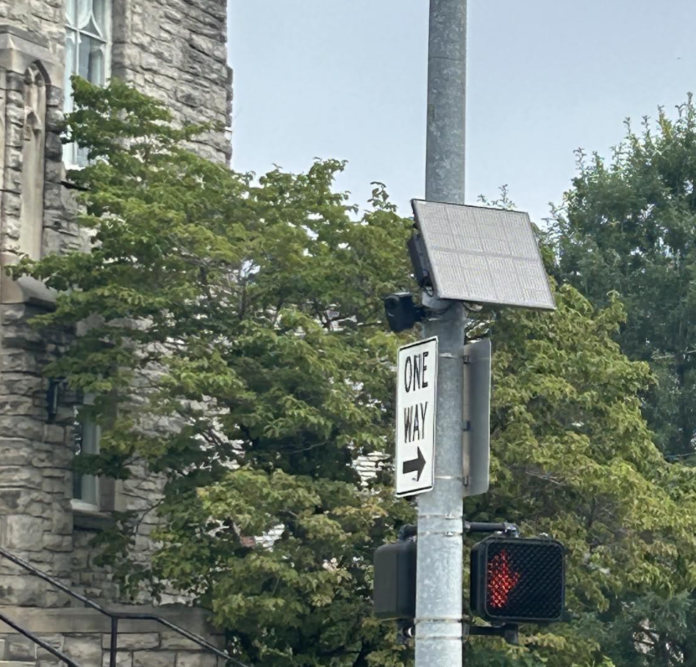
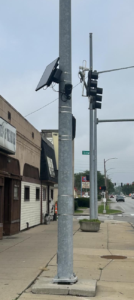
Flock cameras are leased to Toledo by Flock Safety, a Georgia-based public safety technology company. The cameras are commonly mounted on utility poles along busy roads and are also positioned near neighborhood and business entrances.
 When a vehicle passes a Flock camera, the device takes an image that captures its license plate, the color, make and model of the vehicle and other distinguishing details, plus the date, time and the location of the camera that collected the image. This information is stored in a searchable database. The cameras do not record images of the occupants of the vehicle.
Law enforcement officials strongly support the use of Flock cameras, contending that they are an extremely useful tool in crime fighting investigations. By using the Flock technology, police can quickly track down vehicles and locate suspects and, since numerous law enforcement agencies are connected to a data sharing network, police can search through the images captured by many cameras in Toledo and the region during their investigative work.
If a vehicle is identified as possibly being associated with a crime in Toledo, a search of the registration and the owner’s address could lead to a quick arrest. If that same vehicle passes another Flock camera in Detroit or another city, Toledo investigators can narrow their search for suspects.
Use by other local law enforcement
Lucas County and the City of Perrysburg also utilize Flock cameras, and Lucas County Sheriff Mike Navarre and Perrysburg Det. Sgt. Jerrod Parsell is among the strongest proponents of their use in solving thefts, abductions and other crimes.
In late July, a Lucas County Deputy used the license plate reader system to quickly locate a teenage girl who had been abducted. A quick search of the Flock system indicated the location of suspect vehicle and the driver, a man carrying a loaded handgun in his waistband, was detained in the case.
The list of other local crimes that have resulted in an arrest or a recovery of stolen vehicles due to the use of data collected by Flock cameras is significant and includes locating parole violators, tracking and recovering stolen vehicles and apprehending suspected drug dealers.
Criticism of camera use
While many local officials have called the Flock cameras a “valuable tool” for law enforcement, the primary objections to the license plate reader cameras voiced by a minority of Toledo City Council members, and some citizens, have been based on privacy and public safety concerns. A number of elected officials who oppose the use of the Flock system have voiced concerns that the information gathered by the cameras could be used by immigration officials.
The City of Toledo has more than 100 surveillance cameras in use, mostly along main thoroughfares such as Secor Road, Dorr Street, Monroe Street, Sylvania Ave. and Central Ave. There are reportedly approximately 200 license plate reading cameras in use throughout Lucas County. The University of Toledo has added a portable camera trailer to its existing network of 30 Flock cameras, stationed at the entrances and exits of the school’s Main Campus and Health Science Campus.
More on flock cameras
 Flock cameras are becoming a topic of controversy across the United States. An investigation highlighted by AllSides examines why the cameras have generated criticism from both privacy advocates and some law enforcement officials.
The debate is not simply about whether cameras can help police solve crimes. There is little argument that the technology can be useful when investigators are trying to locate a stolen vehicle, find a missing person or identify a vehicle connected to a serious crime. The larger question is how much information should be collected regarding motorists who are not suspected of committing a crime, how long that information should be retained and who should have access to it.
Those questions have become more pressing as the Flock network has expanded and law enforcement agencies have been able to share information across jurisdictional boundaries. Critics say that capability can effectively turn a system designed to identify vehicles involved in crimes into a tool capable of documenting the movements of ordinary motorists.
Concerns about access to the information have intensified nationally. In Los Angeles, police officials halted their relationship with Flock in July amid questions about who controls data collected by the cameras and how it could be shared with other agencies, including federal immigration authorities.
Changes in Flock policies
Flock has responded to the growing criticism with changes to its policies. The company has announced additional auditing requirements and plans to shorten the default period for retaining license-plate data from 30 days to seven days, while also requiring greater documentation of law enforcement searches. Those changes are intended to address concerns about misuse, although privacy advocates continue to argue that stronger independent oversight is needed.
In Toledo, the debate is likely to continue as long as the cameras remain part of the city’s public-safety strategy. The City Council’s decision in June to continue the Flock agreement gives police another year to use the technology, but it also gives city officials, and the public, another opportunity to examine how the system is being used and whether adequate safeguards are in place.
The argument over Flock cameras ultimately comes down to a difficult balance: how to give police the investigative tools they need to protect the public without creating a system of surveillance that reaches far beyond people suspected of committing a crime.
For now, ToledoCity Council has voted to keep the cameras operating locally. The continuing challenge for city leaders will be making sure that the power of that technology is matched by transparency, accountability and clear limits on how the information it collects can be used.
Want to find out where all the flock cameras are? Click HERE.

