
The Toledo City Paper depends on readers like you! Become a friend today. See membership options
How Matt Bell Turned His Own Last Chance Into a Movement That Has Transformed Thousands of Lives
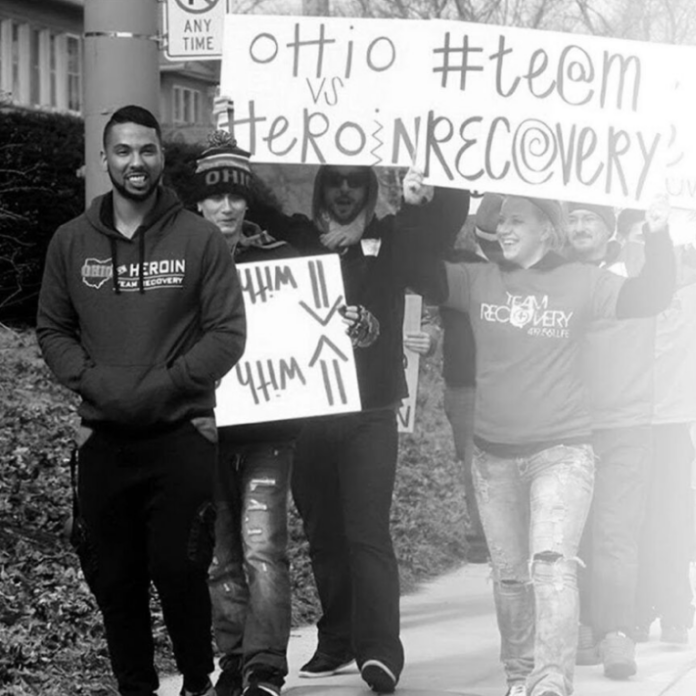
Ten years ago, on October 17, 2015, a handful of people in early recovery stood on a Toledo street corner holding hand-written signs—messages of hope, grief and second chances. Their goal was simple: break the silence surrounding addiction. What they didn’t realize that day was that they were launching a movement that would eventually reshape how an entire region understands recovery.
Today, the City of Toledo honors that grassroots beginning by officially recognizing October 17 as Team Recovery Day, celebrating both the organization and the community that now stands behind it.
A founder forged by experience
For Team Recovery founder and CEO Matt Bell, the 10-year anniversary represents more than organizational success—it marks a decade of grace, healing and purpose.
Bell’s journey began far from the comfort of a boardroom. “Going through 28 treatment centers, I know what it’s like to feel like a number,” he said. “My greatest asset is understanding what we should and shouldn’t do.”
In 2015, Bell was detoxing—sick, sleepless and thinking about his four-year-old son—when he realized something had to change. “I was tired of doing the same thing over and over again,” he said. “I knew this was my last chance. All I was thinking about was my kid. I started thinking about giving back and the gaps in services. I knew I could help.”
With a criminal record that limited job opportunities, Bell began volunteering wherever he could, determined to serve others and repair what addiction had taken from him and his family. One of his early motivations was personal: “Not one treatment center talked to my mother. No one told her what to do if I called and said I wanted to come home, and if I did what she should do. So, I wanted to start family support systems.”
That idea would soon evolve into one of Team Recovery’s earliest and most impactful programs.
RELATED: Copper River Wellness Brings Movement, Community to Toledo
Toledo’s changing culture around addiction
A decade later, Bell has seen the culture shift dramatically. “Things have changed a lot in a positive way,” he reflected. “There’s been so much stigma reduction. People aren’t ashamed of their past the way they used to be.”
He attributes that shift to education, advocacy and the bravery of those willing to share their stories—including through podcasts, community forums and Team Recovery programming. Toledo now has more than 300 treatment resources in Lucas County alone—compared to just 16 when Bell first sought help.
“Overdose rates are decreasing,” he said. “There is so much progress and advocacy. We’ve played a part in this.”
A program built for families, not just individuals
One of Bell’s most powerful memories came just two months into his own sobriety, when a woman reached out on Facebook after losing her husband to fentanyl. Bell didn’t yet have answers—but he promised to try.
Two weeks later, Team Recovery held its first Family Support Group. “I thought maybe a few people would show up—but 60 showed up,” Bell said. “It was overwhelming. It was a wake-up call that we had a lot of work to do, but it gave me a lot of hope.”
That program would grow to welcome hundreds, proving just how many families had been silently waiting for help.
Leadership shaped by growth and education
Bell’s perspective has continued evolving. After earning his master’s degree in social work, he realized how differently recovery can look for each person. “Early in recovery, I was closed-minded—I thought the way I recovered was the right way,” he said. “Now I know there are so many different ways to recover. There is no wrong way. We have to hold their hand but let them lead the way.”
Even as CEO, Bell still shows up daily to do group work, meet with clients and stay connected to the mission. “A lot of people think the founder isn’t there, but I am in the office every single day,” he said. “This isn’t a business to me. This is my calling.”
Looking Ahead: creativity, courage and measured risks
Team Recovery now provides more than 250 recovery-housing beds and continues to expand programming, from family support to plans for a food pantry and transportation network.
“We’re constantly measuring outcomes,” Bell said. “We’re not afraid to take calculated risks. I don’t want anyone else to wish that resources were available for them.”
Asked to describe the last 10 years in one word, Bell chose grace. “If life were fair, I’d be dead or in prison,” he said. “Statistically, I shouldn’t be here.”
Yet here he is—leading a movement he once only hoped might help a few people.
For more information or to get involved, visit:
teamrecoveryfoundation.org
theteamrecovery.org

