
The Toledo City Paper depends on readers like you! Become a friend today. See membership options
Discussing his new novel Contrapposto
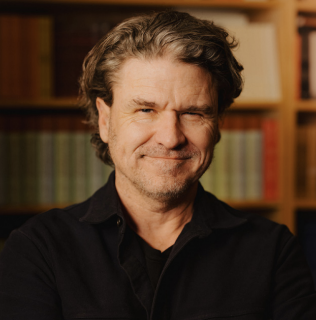
Dave Eggers, award-winning writer and editor, visits the Toledo Museum of Art’s Peristyle Theater, Thursday, June 11. Eggers rose to fame from his 2000 memoir, A Heartbreaking Work of Staggering Genius. He began his writing career with Salon.com and has been featured in The New Yorker, Esquire and The New York Times Magazine.
Eggers’ latest book, Contrapposto, is a novel about two art school students, who finds he has a talent for drawing and a girl he meets while attending art school, Olympia Argyros. She convinces him “to deface, with profound vulgarity, a popular playground,” and under her romantic spell, he complies. The book covers their sixty-five year relationship, encompassing them working together and their love affair. Eggers explains that the’s had the idea for this book since he was in his twenties. Now 56, he still felt there hadn’t been an art world book that spoke to his experience. Eggers shared his thoughts with Toledo City Paper about the book, his creative process, meeting fans and a
project for young readers.
Who inspired Contrapposto and how much of it reflects your own real-life experiences?
There wasn’t any one person who inspired the book, but there are a few details that were formed by personal experience. I wanted to paint a picture of the kind of devotion it takes for two people to remain this close over six decades. There’s a kind of feral loyalty between these two that I wanted to illustrate.
What is your writing process?
I used to love working while everyone slept, but these days I surprise myself by working banker’s hours, 9 to 5. I start the day by reading. I’d been a night reader forever, but now, from about 8 – 9, I read with the morning coffee, and it starts the day infinitely better.
What do you love about books for all ages versus adult novels?
When my kids were young and we were all reading together, I was gobsmacked by the kind of profound enjoyment we got from an all-ages classic like Charlotte’s Web or Bud, Not Buddy or the Tales of Despereaux. There’s a crystal clear narrative and a command of storytelling that I think is unique to all-ages books. I was re-inspired by The Eyes and
the Impossible. It was EB White and Kate Dicamillo and Christopher Paul Curtis.
You formed 826 Valenica, a non-profit writing and tutoring center for children and young adults. How is 826 Valencia doing?
We just had a fundraising gala here in San Francisco with a bunch of students and the great Delroy Lindo and it astounded me how much the current leadership and staff have grown the organization. It started out as a neighborhood center with a staff of two. Now 826 is in every corner of the city, with a thousand volunteers and a staff of 70. These days I get to pop in on programs and occasionally bring a new book back to our International Library of Young Authors.
And how is your publishing house, McSweeney’s, managing to survive the many changes in the publishing market, from AI to the collective attention deficit?
Well, it gets a little harder every year. And the people who make printed books have to be more dedicated — more vigilant and crafty. But McSweeney’s is fully committed to making beautiful, threedimensional, physical book objects, and I think our subscribers and supporters value that attention to detail and tactile pleasure in an increasingly digital and sterile media environment. I don’t think people are ever going to stop liking holding beautiful objects in their hands. and I do believe that survival of print depends on investing in making the most elaborate and sometimes ludicrously beautiful objects we can.
The Toledo Museum of Art is currently involved in reorganizing the collections in chronological order. Contrapposto also uses time and chronology as an element in the story of its protagonists. How did you think about time and chronology in writing this novel?
That sounds like a great way to organize a museum! The viewer loses track of how logically periods in art move from one to the next. I think a certain calm comes over audiences when they see something laid out, with rational linearity. I love books that do that, too — cover decades and centuries with magisterial calm. It puts the chaos of life and history into order, which is the job of writers and artists. We can’t do math, so at least we can do this.
liveartstoledo.com/events/2026/06/11/live-arts-toledo/an-evening-with-dave-eggers/365/

