
The Toledo City Paper depends on readers like you! Become a friend today. See membership options
Rain fell steadily over the Maumee River Saturday morning as members of the University of Toledo women’s rowing team carried their boats from the Downtown boathouse toward the water for the Glass City Regatta.
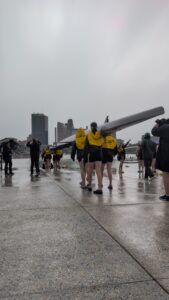
A year earlier, the same event had marked the beginning of Toledo’s competitive history. This time, the Rockets returned with a full season behind them and another chance to measure how far the young program has come.
In a race against their own times, Toledo sent seven boats onto its home course, including three in the women’s collegiate 8+ and four in the women’s collegiate 4+. The Rockets’ fastest 8+ completed the course in 14:29.605, while their fastest 4+ finished in 16:10.872.
Toledo’s fastest collegiate 8+ finished more than two minutes faster than the program’s open 8+ at the same regatta a year earlier.
Assistant coach Abby Goodwin, who has been part of the program since its inaugural season, said the difference goes beyond race times.
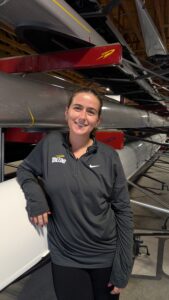
“We’re just so much further ahead than we were last year,” Goodwin said.
For Goodwin, that progress is also reflected in the team itself.
“We don’t really have cliques or kind of sections that aren’t friends with other people,” she said. “It’s really just one big, cohesive family. I would say that would be our biggest success.”
Building a program from scratch
Toledo announced the addition of women’s rowing in 2024 and began competition during the 2025-26 academic year under head coach Chris Bailey-Greene.
Building a Division I program from the ground up meant assembling a roster with vastly different levels of experience. Some athletes arrived with rowing backgrounds, while others had never picked up an oar.
That mix remains part of Toledo’s approach.
Goodwin said the program recruits experienced rowers while also looking for athletes from other sports who have the physical ability, work ethic and mentality to make the transition to rowing.
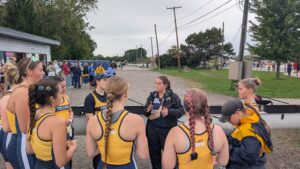
“You get to watch them learn everything from scratch,” Goodwin said.
During the program’s earliest practices, learning how to handle equipment, move together and safely navigate the river represented progress.
Now, with a full season completed, those fundamentals have provided a foundation for coaches to spend more time refining technique and pushing athletes competitively.
Much of that development has happened on the same stretch of the Maumee where Toledo’s competitive history began.
Building a program from scratch
For most of the season, Toledo’s work on the river happens long before much of Downtown is awake.
Goodwin said athletes typically arrive at the boathouse around 5:30am for practices that begin around 6am. The early start also offers an advantage on the water, where conditions can be calmer than later in the day.
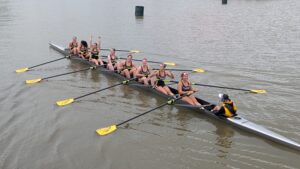
That was true even with Saturday morning’s steady rain.
Assistant coach Anna Can said rain can help calm the Maumee and reduce some of the river’s choppiness, making the dreary conditions potentially beneficial for the rowers even if they were less comfortable for those watching from shore.
The approximately 4,000-meter course stretches along the Maumee through Downtown Toledo. Can said crews warm up by rowing toward the mural near one end of the course before turning and racing downriver toward the National Museum of the Great Lakes.
Rather than racing side by side, boats are sent onto the course separately and race against the clock.
For Toledo, the Glass City Regatta also provides a rare opportunity to bring a sport usually practiced in the early morning into public view.
“To be able to go from something where we’re the hidden team that just kind of moves around campus and gets whatever we need to get done, done, to actually being able to showcase a little bit … is really awesome,” Goodwin said.
The regatta brings together collegiate, high school, club and adult rowers, connecting Toledo’s Division I program with the broader rowing community already established along the Maumee.
Measuring success
With the mechanics of launching a new program increasingly behind them, Toledo’s coaches are also beginning to ask more of their athletes, but not necessarily where they finish.
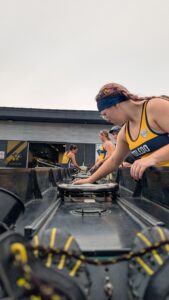
“We’re really big on pushing yourself that extra little bit, being very comfortable being uncomfortable,” said Goodwin said.
“… If each of our athletes hit their ceiling within a race, then we know we’re moving the needle,” she added.
That philosophy is particularly relevant for a program whose athletes arrive with such different levels of experience and that is still establishing itself against programs with much longer histories.
Sometimes, Goodwin said, the best measure of progress has little to do with the final standings.
“If we have athletes who say they got last place, but they all got off the water and they said, ‘That’s the best race we ever could have run. We pushed ourselves all the way to the max,’ that would be success for us.”
The Glass City Regatta gave the Rockets their first opportunity of the new season to find that limit.
Toledo next travels to Pittsburgh for the Yinzer Cup on Saturday, October 17, before competing at the Head of the Schuylkill in Philadelphia and the Bald Eagle Collegiate in Indianapolis. Spring competition begins in April and ultimately leads to the Mid-American Conference Championship in May.
The program is also continuing to build its future roster. No previous rowing experience is required for University of Toledo students interested in walking on, and prospective recruits and current students can find additional information through U-T Athletics.

